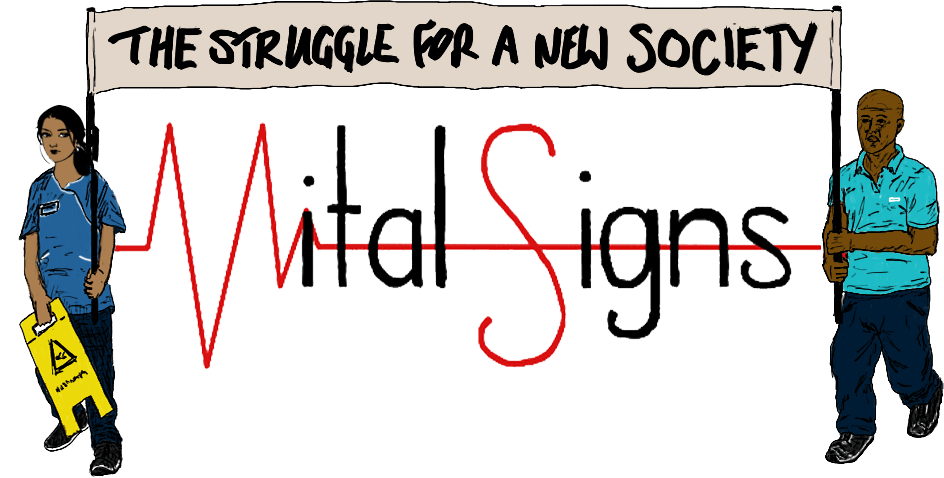

Currently we witness three exemplary disputes in three different workplaces across London. Each struggle represents one of the main frontlines that we currently face as health workers. The struggles are fought by different, but equally exemplary categories of health workers and types of health services. This is a chance to go beyond symbolic solidarity and fuse the struggles into an actual health workers’ movement.
Firstly, at East London NHS Foundation Trust (ELFT), 6,000 mental health workers are confronting the management decision to enforce £24.1 million in ‘savings’ which could result in up to 330 job cuts. ELFT provides mental health and community health services for about 1.8 million people across east London and Bedfordshire. The union Unite announced that it will ballot its members for industrial action. We can see similar struggles around cuts going on across the country – a fellow worker who works for a mental health Trust in Manchester wrote a longer report about his local situation which we will feature soon. These struggles face the dilemma that the state has less and less interest in patching up the massive mental health crisis, in particular amongst working class people. We fight in a defensive situation, in a structurally weak position, if we allow ourselves to be reduced to our immediate workplace. In this situation, where the state rather spends money on re-armament than on suffering working class people, it is difficult to just threaten with ‘strike’. We have to find new ways to exert economic and political pressure on the state and create wider alliances within our class.
Secondly, at Guys and St. Thomas NHS Trust, Unite started to ballot Band 2 workers, meaning cleaners, porters, housekeepers and supply chain workers. The ballot leaflet states that “you deserve a pay rise”, and nothing could be more true and relevant. Hundreds of thousands of Band 2 NHS workers, who might have been working as cleaners or porters for the NHS for decades, drop below the minimum wage whenever the government decides on a moderate increase. This is not just a situation of material hardship. It’s a question of self-respect, whether we allow the state and management to frequently drop a backbone of essential workers below the minimum wage. We are a mass workforce, not victims. The problem is how to be able to fight for a pay increase. The annual pay rounds are rigged in a way that it is very difficult to ballot all Band 2/3/4 workers for strike together. The Unite branch at Guys and St.Thomas decided to enforce the pay increase by demanding a re-banding of the workers from Band 2 to Band 3. This is understandable, as it seems the only way to organise an official industrial dispute. We can also understand the hope that if one group of workers achieves a pay increase via strike, others might feel encouraged to do the same. But to rely on re-banding comes with problems. With re-banding campaigns you have to argue that the particular group of workers does ‘more’ than what their job profile says. You can argue, for example, that porters who carry around medical gases or drive around patients in vans should be paid band 3, not Band 2. This is a slippery slope, because you risk dividing a large group of low paid workers: the porters might be able to get Band 3, but how do you argue a re-banding for cleaners or house keepers? Our argument must be that we all need more and we have to find ways to fight for it together. If we compare the situation of these workers at Guys and St.Thomas NHS Trust to the situation of the 6,000 mental health workers at ELFT, we can see that they might be able to provide an additional mass base and power: there are thousands of Band 2 workers in every Trust, and they need us to run the services.
Thirdly, at the Institute for Cancer Research (ICR) in west-London, 1,200 workers are employed on two sites. Around 400 of them have voted for an indefinite strike against a pay freeze. It is the first strike in the history of the prestigious institute. This strike is outstanding in many ways. It unites manual workers, who take care of materials or engage in cleaning, with science workers. The range of sectors that the science workers engage in is fascinating: they connect to NHS hospitals when running medical trials or analyse medical samples; they provide training courses for doctors and consultants; they have commercial contracts with leading pharmaceutical companies at a moment where these companies have just enforced that the NHS spends millions more on drugs; they collaborate with university departments. These young science workers can shift the culture amongst many different ‘intellectual workers’, who might be individually upset about their conditions, but would not identify with collective working class forms of struggle, such as strikes. Striking ICR workers told us at a meeting in Bristol that many other issues come up during the large picket lines, such as the hierarchical and competitive nature of ‘research teams’, which have to compete for funds, with professors and managers acting as ‘mentoring’ bullies. Around 300 out of the 1,200 workers are on work visas and management just decided to downgrade their visas, which results in a factual pay cut of up to 10%. This situation of an ‘educated’ migrant workforce is a mass condition and this strike could create a spark in all sorts of directions, from software programming to engineering.
The workers at the ICR symbolise the angry contradiction within ‘elite science’ and ‘progressive research’. Their knowledge and sense of social responsibility has to fuse with the mass base of Band 2 hospital workers and with the mass anger of community health workers and their proletarian ‘service users’, who are deprived of help and resources. Our realties are organically linked, we now have to find ways to link our struggles and their goals. These three segments of the health work force could achieve great things together, if they – and we, ourselves – manage to overcome the formal boundaries of the labour law and narrow union structures.


